Cyrus 40 AMP

 To say that Cyrus has applied a consistent design aesthetic to its products rather undersells its commitment to the same approach. For as long as I have been active in the audio industry, it has made use of the same half-width metalwork. Subtle details have changed as to just how black it is and what display it uses, but the basic look has remained undeviating for decades.
With the 40 Series, that all changes. This all-new range takes some of the thinking that went into the XR components and improves it further by placing that work in completely new casework. The 40 AMP is very much in the vein of recent Cyrus integrateds, combining analogue and digital inputs in a manner that makes it more akin to an all-in-one system. In traditional terms, four RCA line inputs are supported by a moving-magnet phono stage, the latter borrowing design-thinking from the superb Classic Phono (HFC 520). These are supported by a fixed-level tape-out and a variable level pre-out.
There is then a digital board built around an ESS Sabre ES9039Q2M DAC and making use of optimised components to enhance performance. At first glance connectivity is slightly down on the more affordable i9-XR (HFC 489) with a USB input, two coaxials and an optical, down from two on the XR amp. The reason for this is that the 40 AMP gains an HDMI eARC connection; a significant boost over connecting a TV by optical (which makes the second optical connection the logical one to lose for the HDMI port). Sample rate handling is PCM up to 384kHZ and DSD256.
The amplifier stage is a development of the thinking that first appeared in the XR devices. It is a Class AB-based design that produces of 100W into 6ohm and, for the first time I can recall, if you add the optional 40 PSU, output will increase further to 115W. There are rival designs that can offer more power, but the 40 AMP does not struggle with anything we partner it with during testing.
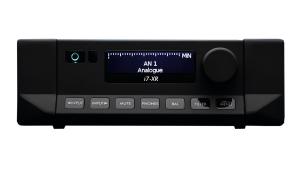
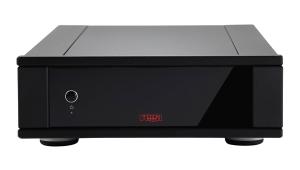
All this comes encased in metalwork that owes northing to anything that Cyrus has done before, although it hasn’t thrown tradition completely to the wind. It’s still a half-width unit that is relatively deep, but from there it is all change. The front panel is dominated by a large, white-on-black display that shows input and volume (and, if other 40 Series devices are employed, information they supply over the proprietary communication connection). We really like the cut-in lower edges (a feature replicated on the remote control) and illuminated ring around the volume, and it feels like a carefully assembled and well executed bit of kit.
Crucially, it also addresses some issues we’ve had for years with the old design. The headphone socket is now – finally – on the front panel and the sockets on the rear panel accept solid-tip 4mm banana plugs, which makes wiring a joy compared with older models. The rear panel is still relatively busy, but none of the connectors are so cramped that they can’t be used and the whole device feels like a neat piece of packaging. The new remote is more elegant than the hefty learning control that the company has used in recent years, but it’s a little less flexible with it.
Sound quality
I connect the 40 AMP directly to the USB out of a Roon Nucleus and use a pair of Focal Kanta No.1 (HFC 454) standmounts for initial testing. The Focal is not an insensitive speaker, but it responds well to being driven rather than simply powered and demonstrates that the 40 AMP has the current delivery needed to be a more than satisfactory partner. The heavyweight bass that underpins Bobby Womack’s The Bravest Man In The Universe is satisfyingly visceral and hefty, and possessed of excellent texture and control.
Further up the registers, the news is no less positive. There was a time when the idea of combining Cyrus with Focal would have been something to be wary of, but like the XR models, the 40 AMP is detailed and lively without any trace of harshness, even when levels are high. If you reach for something very poorly recorded – Placebo’s Meds – the Cyrus cannot help but tell you that there are issues there, but it does so in an almost apologetic way.
There are also recognisable traits that appeared in the XR models that feel further evolved here. The speed and articulation that Cyrus has always excelled at is present and correct, but partnered with a three-dimensional airiness that has never been a huge part of what the company does until now. The massed band backing up Gregory Porter in Revival has the space needed to become a coherent group of musicians rather than ‘a band’ and it makes larger scale music very enjoyable.
Something else that seems readily repeatable is that the digital board gently enhances performance too. While a Chord Electronics Qutest (HFC 436) DAC taking the same USB feed doesn’t open up the same improvement in performance that it did on the i9 XR. The performance via the HDMI eARC connection is also very impressive; with perfect sync and the same dynamics and scale as you get via USB.
You can reasonably argue that the phono stage does not demonstrate the same level of improvement as the digital board, but this is as much a reflection of just how well sorted the internal Cyrus moving-magnet phono stage is as much as anything else. Listening to New Order’s Substance isn’t just good for an onboard phono stage, it’s a genuinely impressive way to enjoy records. The 40 AMP doesn’t seek to alter the fundamentally Eighties sheen that the production of this record has in spades, but it extracts more from Bernard Sumner’s vocals and the backing instruments than is generally the case. It then goes ahead and delivers everything with the necessary speed and clout you might reasonably expect a Cyrus amplifier to possess. The result is genuinely compelling.
Something else worth noting, is just how consistently it delivers these positive traits. Testing with the DALI Rubikore 2 and Neat Petite Classic (HFC 521 and 495 respectively) sees the personality traits of these speakers mesh very effectively with the 40 AMP. Meanwhile, some brief testing with the Kudos Titan 505 (HFC 460) – a speaker more than twice the price and quite a demanding drive – shows that the circuit in the Cyrus has the grunt required to partner it effectively.
Conclusion
What results is an amplifier that is still very much a Cyrus, but one that feels as much of an evolution on the inside as it does externally. Without a single retrograde step over things that the company has long done so well, the 40 AMP is more spacious, refined and confident. This improved performance is then made available to a connection set that is entirely up to date and allows you to use the Cyrus in the way you want rather than how the company dictates. If this is the future for Cyrus, I for one am very much on board with it. ES
DETAILS
Product: Cyrus 40 AMP
Type: Integrated amplifier
FEATURES
● Quoted power: 100W per channel (6ohm)
● Four line inputs on RCA
● Moving-magnet phono stage
● Digital board with USB; 2x coaxial; optical; HDMI eARC
Read the full review in Issue 526
 | ||||

|
|
|||














 |
Inside this month's issue:
Ruark R610 music system and Sabre-R standmount speakers, PMC twenty.23i Active, floorstanders, English Acoustics Downton preamplifier, Bluesound NODE ICON preamp/streamer, Ortofon Concorde Music Blue MM cartridge and much, much more
|







| Equipment Reviews | |
Features | |
Latest News Awards Newsletters | |
Resources | |
Subscriptions |
WHERE TECHNOLOGY BECOMES ENTERTAINMENT
 © 2026 Hi-Fi Choice
AVTech Media Ltd
All rights reserved