English Acoustics Downton

 Preamplifiers are a dying breed. Given that so many people only use digital sources these days and that so many DACs have multiple inputs and output level controls built-in, it’s not unreasonable to ask why anyone would buy one. Yet many audiophiles reckon that a good active type confers many benefits, not least the gain to properly drive pretty much any power amplifier. And at the same time, the passive volume controls in DACs are often poorly implemented, in sonic terms.
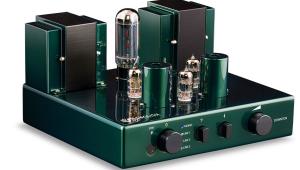
Products such as English Acoustics’ new Downton make a strong case for preamplifiers in general. It’s a bespoke ‘clean-sheet’ all-valve design that gives a claimed 6dB of gain to line sources and 44dB to moving-magnet phono sources. Apropos of the latter, the company says that its phono stage follows the RIAA curve with 99 percent accuracy, which is no small boast.
The Downton offers bass and treble tone controls, which are implemented using the legendary Baxandall circuit from the Fifties. They give ±12dB of boost/cut at 100Hz and 10kHz respectively. Designer Peter Farrow says this complements the tone stacks used in audio mastering suites. It’s an interesting philosophical point, because of course no listening room is tonally neutral, so it makes sense to be able to gently tailor the tone to suit the speakers being used and your room acoustics. When in their centre positions, the response is completely flat, says Farrow.
The valve complement has been carefully chosen. The 5U4GB works as a full wave rectifier (a GZ34 can also be used). A single 12BH7 dual triode cathode follower feeds the ECC83-powered Baxandall tone stack amplifier, then the volume control. There’s an ECC82 triode shunt feedback gain stage to make up for attenuation from the tone stack and cathode follower. Then comes the 12BH7 cathode follower output stage, with its low output impedance for decent line-drive capability.
The two ECC83 dual triodes provide dedicated gain for the phono stage. The quoted input sensitivity is 4.5mV, which is close to the level you get from Audio-Technica’s popular AT-95VM moving-magnet, for example. There’s no provision for MC carts, so users of low-output pick-ups will have to use an MC-compatible phono stage through one of the three line inputs or moving-coil step-up transformers. The preamp is supplied with gold pin JJ valves, with Tungsol as an alternative.
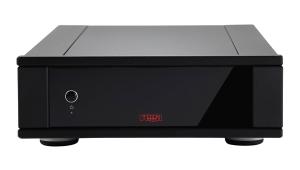
Downton comes in a wide choice of standard colours and can be supplied in any conceivable hue to order, at extra cost. This hand-built product is exquisitely turned out, with an immaculate gloss-lacquered paint finish as good any new premium car. Sound quality This preamplifier’s many admirable attributes include a delightfully creamy tonality, excellent insight, rhythmic fluidity and a capacious three-dimensional soundstage. Also, it boasts extremely low noise for a valve preamp, with no hiss or hum audible. You wouldn’t call it absolutely neutral in tonal terms, but its butter-smooth sound is hard to live without.
Much of the review period is spent with the Downton driving a Sony TA-N86 solid-state Class A power amplifier or a K5881 tube power amp. It sounds great with both, but its Teflon-smoothness makes it an ideal synergistic match for the Sony, which is just a touch on the chilly side, tonally. The source is Chord’s Hugo TT2 (HFC 468) DAC in either fixed (line) output mode or using its own variable out. Using the Downton instead of the DAC’s variable output enhances not just the tonality of the recording, but also its size. It gives a larger window on the world, inside which everything is more colourful. You could argue that this is an artificial effect, but the counter to this is that it’s not ‘greying’ the sound.
Cue up The Association’s Along Comes Mary and the Downton quickly captures the band’s amazing tightness exceedingly well, alongside the recording’s delightful depth and breadth. The same magic happens with Jimi Hendrix’s superlative All Along The Watchtower. It’s a slightly ropey recording, but sounds wonderfully expansive and gutsy here.
The Downton’s midband is quite a thing to behold, as David Bowie’s Ashes To Ashes demonstrates. This preamp has tremendous insight, and proves able to convey his distinctive vocal line in all its fragile glory. Rather than the opaque, grey, slightly flat sound that many DAC volume controls serve up, here Bowie’s voice sounds vibrant and alive, with wonderful timbre. Although not coloured to the point of sounding false, there’s a warmth to his voice that makes things sound eerily lifelike. Likewise, Sara Blackwood’s vocals on Dubstar’s Not So Manic Now come across with more vibrancy and body via the Downton, than using the Chord Hugo TT2’s variable output.
The grinding modern techno of Deadmau5’s Strobe shows another great side to this preamp. Its bass control is excellent, yet it’s also highly tuneful and fluid. Totally absent is the sort of matter-of-fact, workmanlike bassline that many solid-state preamplifiers serve up. Instead this preamp sets up a hypnotic groove that’s hard to live without. The same can be said with Aphex Twin’s Windowlicker, which is about as far away from an audiophile recording as can be. Yet this little preamp takes masterful control of the mix and serves up a tight, pulsating sound that slots everything together rhythmically.
It’s difficult to fault, even at this price. Arguably its only downside is that it lacks balanced operation. Some purists won’t like this, but others won’t be in the least bit bothered. In absolute sonic terms it lacks just a touch of transparency and there’s a subtle softening of dynamic peaks. Yet its delicate, atmospheric treble more than makes up for this. Indeed its sheer breadth of ability shines through with a London Philharmonic Orchestra reading of Ralph Vaughan Williams’ A London Symphony. It’s an exhilarating listen that’s tremendously musically articulate.
Last but not least is the moving-magnet phono stage. Some people will not buy the Downton for this, but it’s great to know you’ve got it. A Technics SL-1200G/Ortofon Concorde Music Bronze spinning The Stone Roses’ Fools Gold shows its intrinsic quality; there’s a lovely, lilting groove from the percussion and rhythm guitar that transports you right to the heart of the music. It’s infectiously fluid – dreamy, even – and a reminder of just how special well-designed valve phono stages can sound.
Conclusion
English Acoustics’ new Downton preamplifier is a fine design from this newish British company. From its charmingly svelte sound to the excellent build and finish, it’s hard not to like – and makes the case for preamplifiers as well as anything I’ve heard in a very long time. NT
DETAILS
Product: English Acoustics Downton
Type: Preamplifier
FEATURES
● 3x RCA line in; 1x tape out; 1x pre out
● 1x moving-magnet phono input
Read the full review in Issue 527
 | ||||

|
|
|||





















 |
Inside this month's issue:
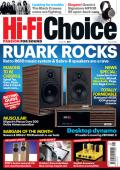
Ruark R610 music system and Sabre-R standmount speakers, PMC twenty.23i Active, floorstanders, English Acoustics Downton preamplifier, Bluesound NODE ICON preamp/streamer, Ortofon Concorde Music Blue MM cartridge and much, much more
|







| Equipment Reviews | |
Features | |
Latest News Awards Newsletters | |
Resources | |
Subscriptions |
WHERE TECHNOLOGY BECOMES ENTERTAINMENT
 © 2026 Hi-Fi Choice
AVTech Media Ltd
All rights reserved