Pro-Ject T1 EVO
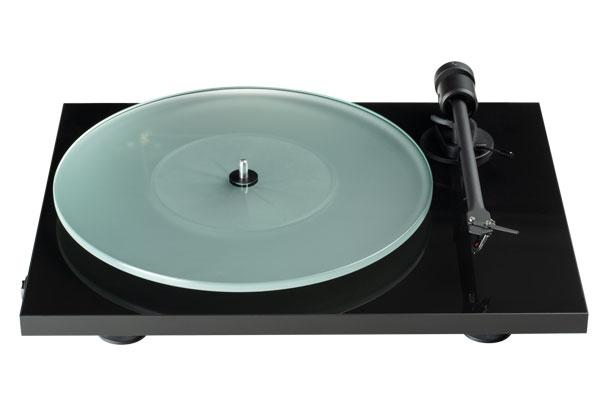
 When the Debut arrived on the market many years ago, it represented both the bottom rung of the Pro-Ject range and pretty much the cheapest fully functional turntable on the market. It’s a mark of how much of a journey it has undergone that not only is it far from the most affordable model that the company makes, but those below it now have tiers of their own. The T1 models replaced the Essential range (which in turn was the first real sub-Debut series Pro-Ject made) in 2020 and the company has now updated the three models to become the T1 EVO family.
These models all share the same basic platform, which is recognisably similar to the original T1. This is still a belt-driven, unsuspended turntable that, unusually for Pro-Ject, uses a felt mat-topped glass platter sat on a sub-platter that the belt acts on. All three models benefit from this sub-platter being upgraded to a more substantial device that looks and feels more akin to the one that’s used on the Debut models.
The tonearm is also employed by all three models. It’s 8.6in in keeping with Pro-Ject design practice and is made from aluminium. The design is simpler than the one used on the Debut models. There is no adjustable anti-skate and each turntable ships with the counterweight both set and then secured in place. On all three samples that arrive this is set sufficiently accurately that there is no need to make any further adjustment. This does mean that fitting a different cartridge to the T1 EVOs is not quite as straightforward as it might have been on the Debuts, but Pro-Ject appears to be gambling that most owners are unlikely to do this.
A factor that helps here is the fact that the supplied cartridge has been improved. The Ortofon OM5e of the originals has now been updated to an OM10. It uses the same bonded elliptical stylus as the OM5e, but the frequency response is improved and the compliance is better. In a category where everything makes a difference, it’s a useful step forward. The OM10 itself is a bit of an oddity as it seems to have disappeared as a live model from the Ortofon website, but is clearly still available if you want a job lot of them. There are further stylus upgrades available, which have the benefit of working with the fixed antiskate on the arm.
One last tweak for the T1 EVO family is more of a logical revision than an out-and-out change. When the original T1s appeared, for reasons that were somewhat unclear, only the T1 Phono had electronic speed control as both the non-phono and Bluetooth version relied on the user switching the belt between pulleys. The T1 EVO models now all benefit from speed being adjusted via a switch on the side of the plinth. Where the three differ is how they handle the signal once it has been transmitted down the arm.
On the basic T1 EVO, it leaves via a captive interconnect at the base of the arm and out to an external phono stage. The T1 EVO Phono has an internal moving-magnet phono stage built into a small metal chassis suspended under the plinth. This terminates in RCA connections and Pro-Ject supplies a good-quality cable in the box. You have the option to switch this phono stage out of the circuit should you wish to upgrade at a later date, which is a neat touch.
The T1 EVO BT is the most novel of the three models. As well as the phono stage of the EVO Phono, it is equipped with a Bluetooth transmitter that can be used to wirelessly transmit to a suitable Bluetooth source. There are two RCA outputs; one making use of the internal phono stage and one without, so even if you are using an external stage, the Bluetooth signal can still be generated. The module supports aptX HD for a respectable bandwidth.
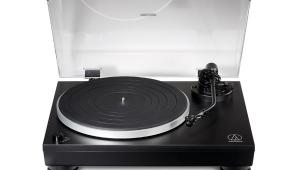
All three models are visually identical viewed from the front and this is no bad thing. The T1 is very visibly a Pro-Ject product, but the glass platter and simplified tonearm help it to look more elegant than some pricier models. This has to be judged against the more limited upgrade ‘stretch’ that the T1 EVOs have compared with more complex designs. UK distributor Henley Audio has taken the opportunity to send all three finishes over and, while the Walnut is pleasant enough, the White and Black Gloss options really suit the design and are the real standouts. All three come with a lid, which is a welcome addition to any turntable that has to share a house with children and/or pets.
One last element is something of a Pro-Ject party piece. The T1 EVO is equipped with feet that put most similarly priced rivals to shame. Without being overly large or ridiculously soft, they afford the playing surface a degree of isolation that means using normal furniture to place a T1 EVO on will give better results than most key rivals and speaks to a level of experience on the part of Pro-Ject as to how its turntables are likely to be used.
Sound quality
Testing the three T1 EVOs in a manner that gives some consistency to the results is helped by the presence of an Audiolab 9000Q preamp and matching power amp. The 9000Q has the required RCA input, good-quality moving-magnet phono stage and decent Bluetooth connection needed to ensure that the three models can be tested with consistency of partnering equipment, so it is used throughout listening.
Kicking off with the standard T1 EVO, making use of the Audiolab’s internal phono stage, the performance isn’t simply ‘good for an affordable turntable’, it’s a genuinely enjoyable showing. Kessoncoda’s Outerstate is presented in a way that captures the exceptional combination of jazz and electronic music, and has you focusing on its flow. This ‘Pro-Ject flow’ is something we’ve commented on before in reviews and is gently but noticeably different to how brands like Rega present. This is not an urgent sound and there are points with high-energy music that feel like it lacks the last ounce of excitement.
The counter to this is that with the more relaxed tempo of the Kessoncoda piece, the T1 EVO is beautifully judged. Everything feels unforced, but never languid and it ensures that the Pro-Ject can handle a wide spread of material in a very even-handed way. When compared with more expensive devices, there are limitations to both the bass extension and some fine detail retrieval, but these only really reveal themselves when a more capable turntable is directly on hand to compare it with.
Not everything is perfect, however. We find that all the samples tend to struggle with wear on records that other turntables do not. With the EVO Phono sample we also discover that every once in a while a noise seems to be audible from the arm towards the end of the side of a record that appears to be something to do with the internal antiskate. Other turntables at this sort of price can exhibit similar foibles, but this stands in contrast to the latest iteration of the Debut – which was completely unaffected by such issues.
When the T1 EVO Phono is put in place of the standard, T1 EVO (initially with the phono stage switched out of the circuit), the good news is that if you decide to upgrade at a later date, the result is effectively entirely transparent. We aren’t able to determine any meaningful difference between the T1 EVO and EVO Phono running bypassed. Switch the phono stage into the circuit and the news remains good. Like most affordable Pro-Ject’s, the T1 EVO Phono is powered via a two-wire, 15V wall-wart PSU, which has no apparent ground but it is possible to connect without the ground wire and get no hum – quite a neat trick.
In performance terms, the EVO Phono can keep the internal phono stage of the Audiolab honest. There is a fractional reduction in the bass extension present on Leftfield’s Leftism, but we find the internal phono stage to be tonally sweeter than the Audiolab one, which gives Toni Halliday’s fabulous vocal turn on Original a little more warmth and emotion. Used via the phono stage, the T1 EVO Phono is almost impossible to provoke into sounding hard or aggressive and that same rhythmic balance is retained.
Substituting the T1 EVO BT doesn’t do anything to change the perception formed by the more conventional members of the range. The switch to there being two different RCA outputs doesn’t result in any change to performance that we can determine and the phono stage that it uses appears to be exactly the same as the one in the more conventional EVO Phono and the performance is every bit as proficient. If you want to use it as a conventional turntable, it’ll very much behave as one.
The Bluetooth section is another interesting addition. Connecting the Pro-Ject to the Audiolab is less trying than some pairings we’ve made in the past. As the Audiolab has a display, it’s fairly simple to see when connection had been made. Conversely, a Naim Mu-So Qb (HFC 409) – which makes do with rather less visual cues – takes a great deal longer to successfully pair up.
Having done so, the performance that results is a genuine reflection of the character of the turntable. The Audiolab connected via aptX HD and the positive traits of the T1 EVO turntables when listening to Joan Armatrading’s Walk Under Ladders makes the transition over wireless. The Naim only supports AAC as an additional codec, which means as the Pro-Ject is not so equipped, only the default SBC codec is available and this is rather less characterful; losing both some of the tonal richness and quite a bit of fine detail. More positively, the 4m distance between the Naim and Pro-ject that also has a wall in the way still results in an entirely stable performance. All of which means the notional dream of cooking while stopping at regular intervals to change the side of a record is entirely achievable.
Conclusion
Ultimately, whether or not the wireless capability of the T1 EVO is going to appeal is for you to decide, but the fact that versions of the same turntable exist both without Bluetooth and the phono stage mean you don’t have to have it if you don’t want it. We reckon plenty of people are likely to want a T1 EVO, though. What these revised models do is take a design that was fundamentally very good and employ some useful tweaks to make them more compelling. The presence of the all-conquering Debut models at a few hundred pounds more will mean that they spend the extra to get a more capable turntable, but that’s hardly going to be something that Pro-Ject complains about. The T1 EVOs demonstrate a further evolution of the ‘sub-Debut’ models into a flexible and capable range, and the results are very impressive indeed. ES
DETAILS
Product: Pro-Ject T1 EVO
Type: Belt-drive turntable
FEATURES
● 33 and 45rpm electronic speed control
● 8.6in tonearm
● Ortofon OM10 cartridge
● Optional onboard MM phono stage
Read the full review in Issue 526
 | ||||

|
|
|||






















 |
Inside this month's issue:
Ruark R610 music system and Sabre-R standmount speakers, PMC twenty.23i Active, floorstanders, English Acoustics Downton preamplifier, Bluesound NODE ICON preamp/streamer, Ortofon Concorde Music Blue MM cartridge and much, much more
|







| Equipment Reviews | |
Features | |
Latest News Awards Newsletters | |
Resources | |
Subscriptions |
WHERE TECHNOLOGY BECOMES ENTERTAINMENT
 © 2026 Hi-Fi Choice
AVTech Media Ltd
All rights reserved